
Sign Up / Sign In

Profile
Exclusives


Account
NBL27 Indigenous Round jerseys revealed
Share


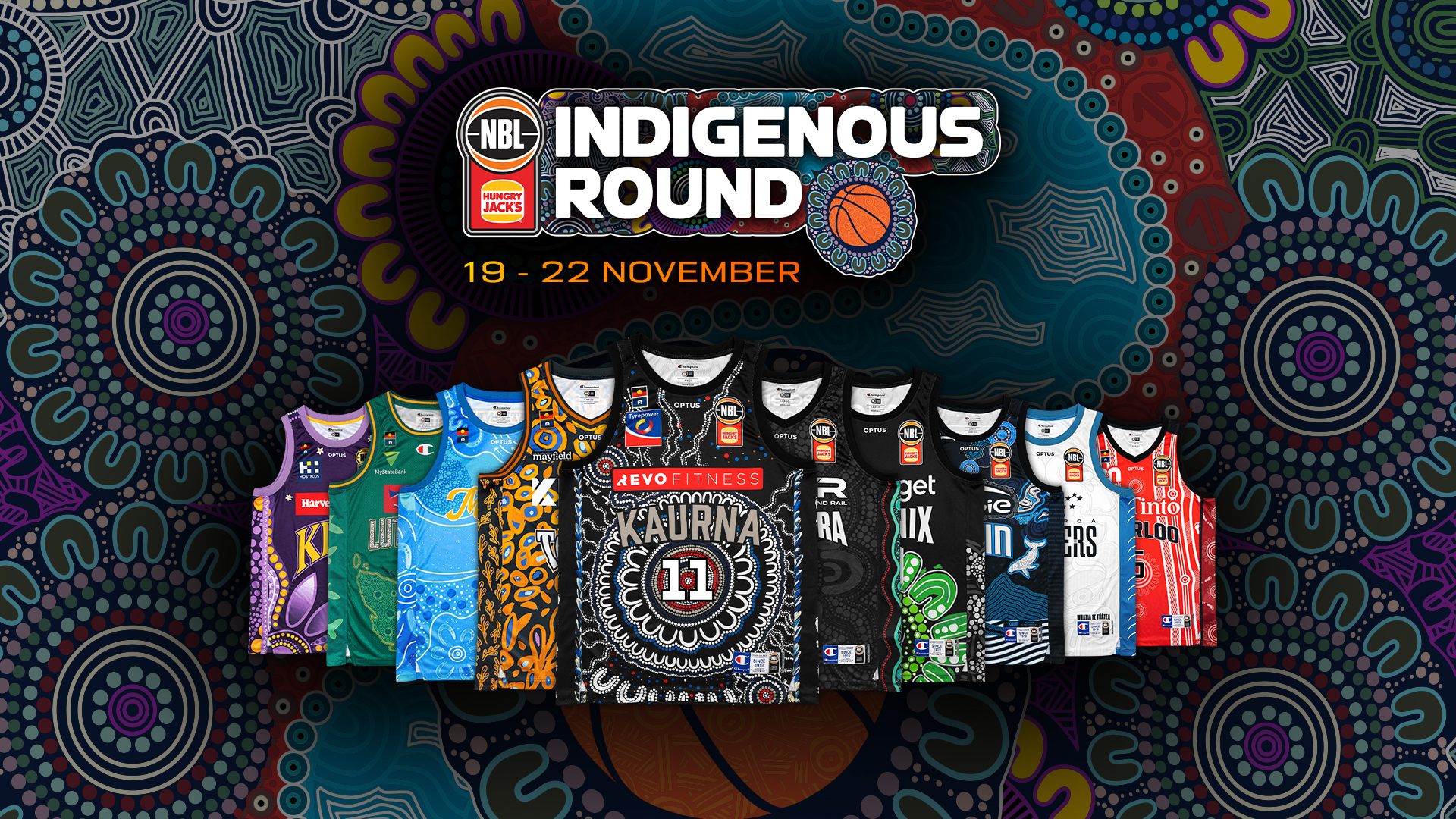
Check out the stories and designs around each of the Indigenous Round jerseys for NBL27.
By
NBL.com.au
The Hungry Jack's NBL's Indigenous Round will be held during Round 10 of the 2025-26 season.
Every club's jersey has a unique story, with all the details explained below once revealed by each team.
>> BUY YOUR FAVOURITE TEAM'S INDIGENOUS ROUND JERSEY NOW

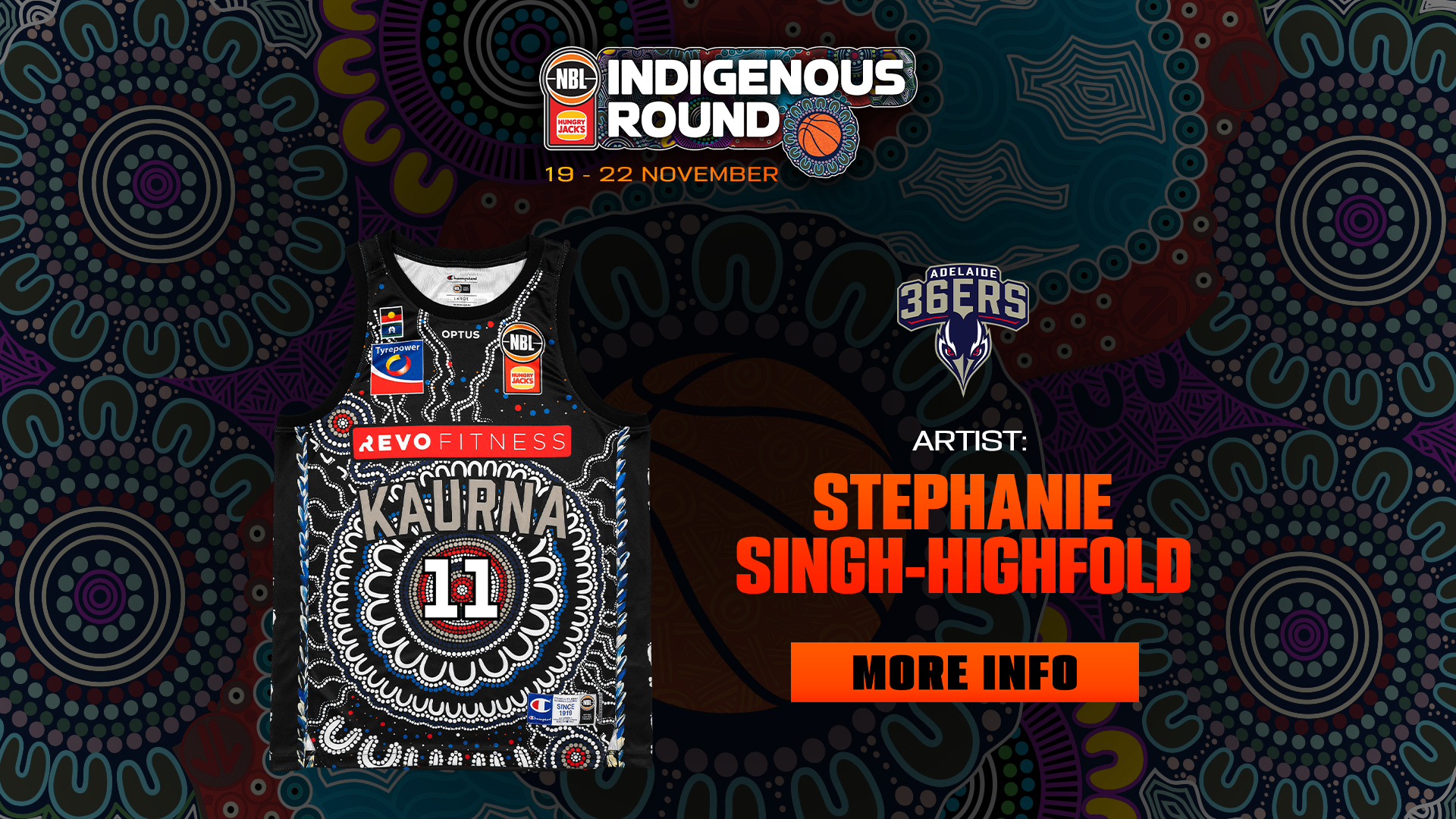
Artist: Stephanie Singh-Highfold.
Artist bio: My name is Stephanie Singh-Highfold, I’m a proud Ngarrindjeri, Kokatha, Warlpiri woman from Adelaide, SA.
I am the owner and artist of Nabanunga – Contemporary Aboriginal Art which I named after my skin name given to me by Emily Rankine, a Warlpiri woman from Ali Curung, north of Alice Springs where I was born.
My connection to country is with Raukkan on my mother’s side located on the shores of Lake Alexandrina southeast of Adelaide. I’m Kokatha on my father’s side who are originally from Koonibba northwest of Ceduna.
My journey started in 2020 when I turned a hobby into a business. My vision for Nabanunga is to celebrate First Nations people and culture through my art which plays an integral part on the path to Reconciliation in Australia.
Artwork story: At the heart of the artwork sits a central depiction of the stadium, with the club’s colours flowing through it, connecting the surrounding players and coach.
Encircling this core are smaller U-shaped figures representing staff, volunteers, members, fans, and the broader South Australian community, all united in their strong support for the club.
In the upper corner, a magpie appears as a guardian of the land, watching over the club and its people.
Extending outward, smaller community elements link the club to its past, symbolising previous venues, while accompanying footprints reflect the journey of members as they move toward their new home.
Along the base, five prominent U-shaped figures honour the club’s legends, who continue to watch over.
Surrounding the composition, blue leaves signify healing and strength, while a trail of white dots flowing toward the centre represents the club’s journey, achievements, and enduring connection to Kaurna land.
>> BUY YOUR FAVOURITE TEAM'S INDIGENOUS ROUND JERSEY NOW

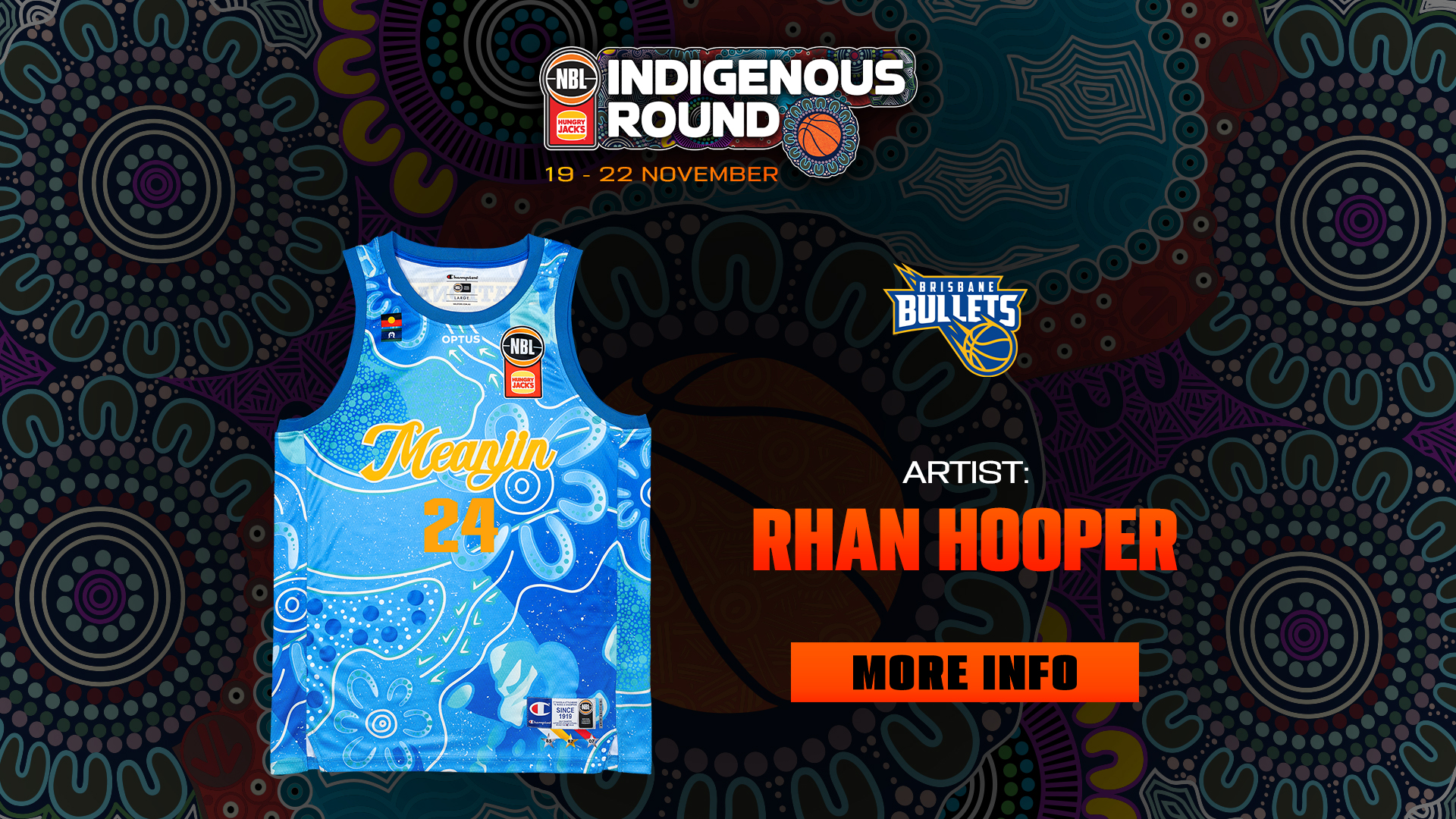
Artist: Rhan Hooper.
Artist bio: Rhan Hooper is a proud Kooma and Kunja man from Cunnamulla.
A former AFL player from Hawthorn Hawks and Brisbane Lions, Rhan now focuses his time as a cultural educator and artist.
He has previous experience designing a range of Indigenous jerseys both in and outside of basketball – including NBL1 team Ipswich Force and BBL side Brisbane Heat.
Artwork story: The jersey depicts the South East Queensland region represented by the Brisbane Bullets in the NBL.
The three yarning circles on the jersey’s front represent the region’s major cities (Sunshine Coast, Brisbane, and the Gold Coast) and the lands of the Gabi Gabi, Turrbal and Yugambeh people, with the Brisbane River (Maiwar) running inland towards the lands of Wakka Wakka and Yagera people.
The players are at the centre of these elements, surrounded and supported by their individual communities.
The Emu and Kangaroo prints through the heart of the jersey represent the Kooma and Kunja country – Rhan’s ancestral home – while the hands represent the elders of the community.

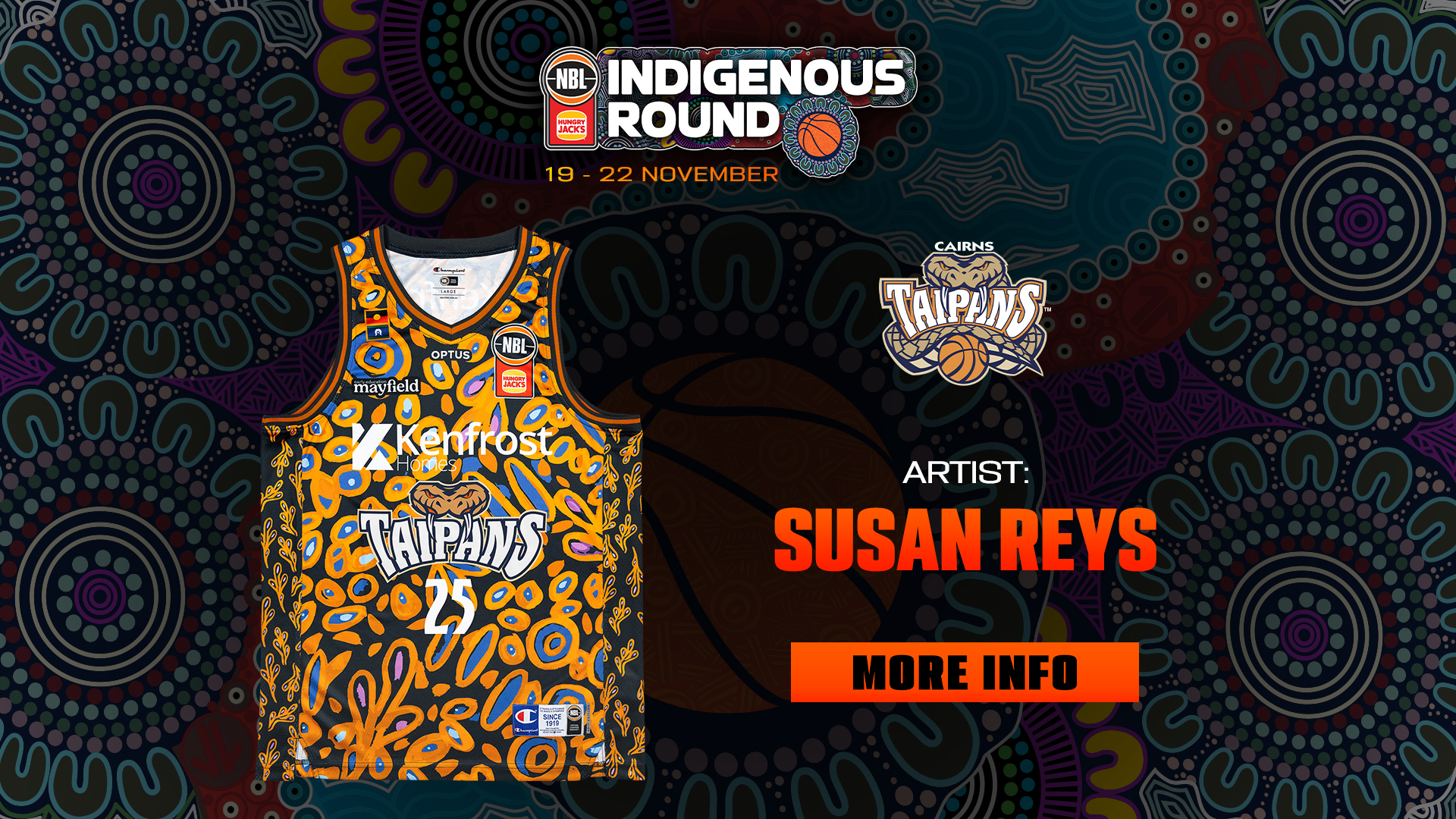
Artist: Susan Reys.
Artist bio: Born and raised in Cairns, Susan Reys has strong cultural connections through her father, who belonged to the Jirrbal people, and her mother, whose heritage traces to the Butchulla people and the Daarba Clan.
Known by her Aboriginal name, Duliny, meaning “owl,” she carries the Waandaar (White Cockatoo) and Dolphin as her totems.
Susan values her deep understanding of her family’s history and lineage, drawing on this knowledge to continue the long-standing traditions of Aboriginal storytelling and artistic expression.
Working from her home studio, she creates canvas paintings, textile designs, and pieces using stoneware glazes.
Her art is influenced by symbols found in rock art, carved trees across her Country, and the patterns traditionally drawn in the sand during storytelling practices that remain part of living culture today.
Since first exhibiting in 2000, Susan has built a successful career as an artist and now operates K’gari 3 Sisters, a Cairns-based business specialising in authentic Aboriginal art.
Artwork Name: The Spirit of Country We Wear.
Jersey design story: This Cairns Taipans jersey design is grounded in vibrant Indigenous artistry, shaped by the colours, stories, and energies of Country.
The palette draws from the deep blues and purples of the mountains, the cool tones of our waterholes, and the warm colours of the land — bringing together the identity of Country and the spirit of the Taipans.
Flowing forms move across the jersey like water and landscape, echoing the living presence of native plants and the places that sustain us.
At the centre sit three message sticks, representing the lores that guide us: our responsibility to care for Country, to care for each other, and to uphold the cultural practices that strengthen spirit and community.
These elements anchor the design, reminding us that culture is not separate from sport — it is carried, worn, and lived.
The jersey stands as a celebration of connection, resilience, and pride.
It brings the stories of the Far North onto the court, honouring the past while empowering the next generation to continue our cultural practices and keep our relationships with Country strong.
>> BUY YOUR FAVOURITE TEAM'S INDIGENOUS ROUND JERSEY NOW

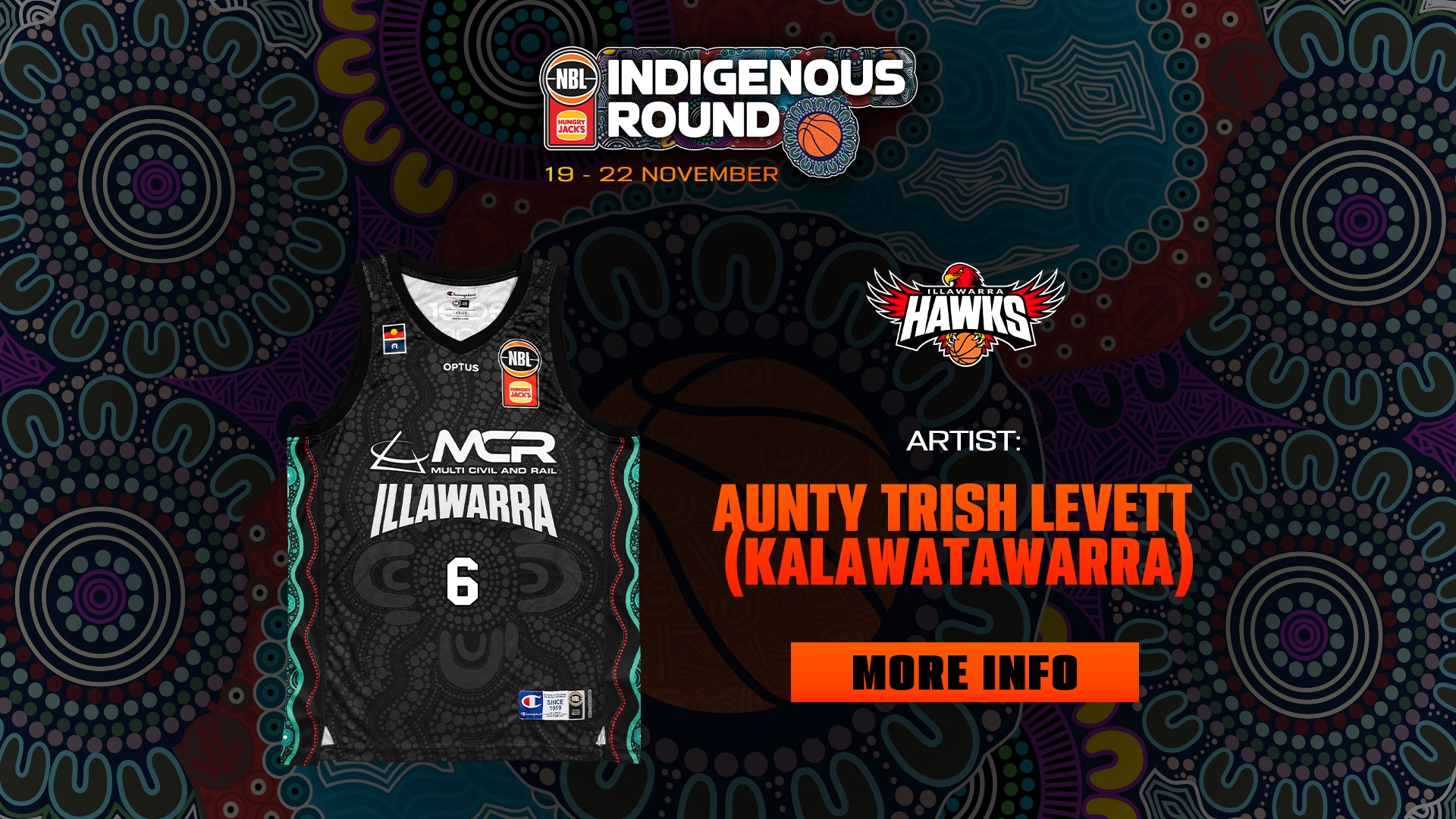
Artist: Aunty Trish Levett (Kalawatawarra) – Holder of Knowledge.
Artist bio: Aunty Trish Levett, traditionally known as Kalawatawarra (Dragonfly), is a proud Gundungurra woman from the Southern Highlands of New South Wales, with deep ancestral connections to the mountains, rivers, and landscapes of Gundungurra Country around Mittagong.
Born and raised on her traditional Ngurra (Country) and now residing on Dharawal Country, Aunty Trish draws inspiration from the stories, waterways, sacred places, and cultural knowledge passed down through generations.
With more than 35 years of artistic practice, Aunty Trish is dedicated to preserving, sharing, and celebrating Gundungurra Dreaming stories and cultural knowledge.
Her work encompasses painting, illustration, cultural education, dance, language revitalisation, and caring for Country, particularly the protection and preservation of sacred sites.
Working across a range of mediums, she has a special affinity for creating with traditional ochres gifted by Mother Earth, connecting her artwork directly to Country and culture.
Aunty Trish recently became a Director of the Gundungurra Foundation, further strengthening her commitment to supporting community healing, cultural education, and the continuation of traditional practices for future generations.
A highly respected artist and cultural knowledge holder, Aunty Trish has exhibited extensively throughout New South Wales, including at Parliament House in Sydney, where she received a Highly Commended Award for her artistic excellence.
Her artworks are held in private and public collections both nationally and internationally, and she has created significant cultural designs, logos, and commissioned artworks for a wide range of organisations.
Aunty Trish is also widely recognised for her ongoing cultural design work with the Illawarra Hawks, contributing artwork for the NBL Indigenous Round over several years and designing the Australian Indigenous NBL jersey.
Through these collaborations, she brings Gundungurra stories and cultural perspectives to broader audiences across Australia.
As an author and illustrator, Aunty Trish created Magurrung, a children’s book that tells the story of the endangered crayfish found on Gundungurra Country.
The book is now used as an educational resource in local schools, supporting cultural learning, environmental awareness, and the sharing of First Nations knowledge with younger generations.
Through every aspect of her work, Aunty Trish continues to honour the teachings of her Ancestors, carrying forward a message of respect, responsibility, and connection to Country:
“Walk gently on Mother Earth and care for her, for she provides everything we need to survive.”
Her practice reflects a lifelong commitment to culture, community, and the preservation of Gundungurra knowledge for future generations.
Artwork Name: Connection to Country.
Artwork story: This artwork, Connection to Country, reflects the relationship between Country, culture, and ancestral knowledge.
At the centre of the painting are the double U-shapes, representing Holders of Knowledge (Elders) gathered at a sacred ceremonial site. These figures symbolise the passing of cultural knowledge, storytelling, spiritual connection, and the continuation of our traditions that have sustained our people for countless generations.
The four circles positioned throughout the background represent the four cardinal directions—North, South, East, and West. They acknowledge the interconnectedness of all lands and peoples and remind us that cultural knowledge extends across Country, connecting communities through shared histories, responsibilities, and kinship.
The ochre-coloured landscape reflects the rich natural pigments found on Mother Earth. Ochres are among the oldest known pigments used and hold deep cultural, spiritual, and ceremonial significance for our peoples.
For thousands of years, ochres have been used in rock art, body adornment, ceremonies, and cultural practices. Each colour carries its own meaning and connection to Country, identity, and spirituality.
Flowing across the artwork are the blue wavy lines, representing rivers and waterways that sustain life and connect communities across Mother Earth. The circles within the river symbolise sacred waterholes – places of gathering, healing, teaching, and spiritual significance.
Water is central to life and has always played an important role in the movement, survival, and cultural practices of our people.
Beneath the river lies the earth and mud, representing the healing gifts provided by Country. For thousands of years, our people have recognised the therapeutic properties of natural clay and mud.
Traditionally, mud has been used to support physical wellbeing, assist with inflammation and joint pain, cleanse and rejuvenate the skin, and promote a sense of balance and connection.
Connection to Country celebrates the wisdom of Holders of Knowledge (Elders), the sacredness of water, the healing qualities of the land, and the unbroken cultural connections that continue to guide and strengthen our people today.

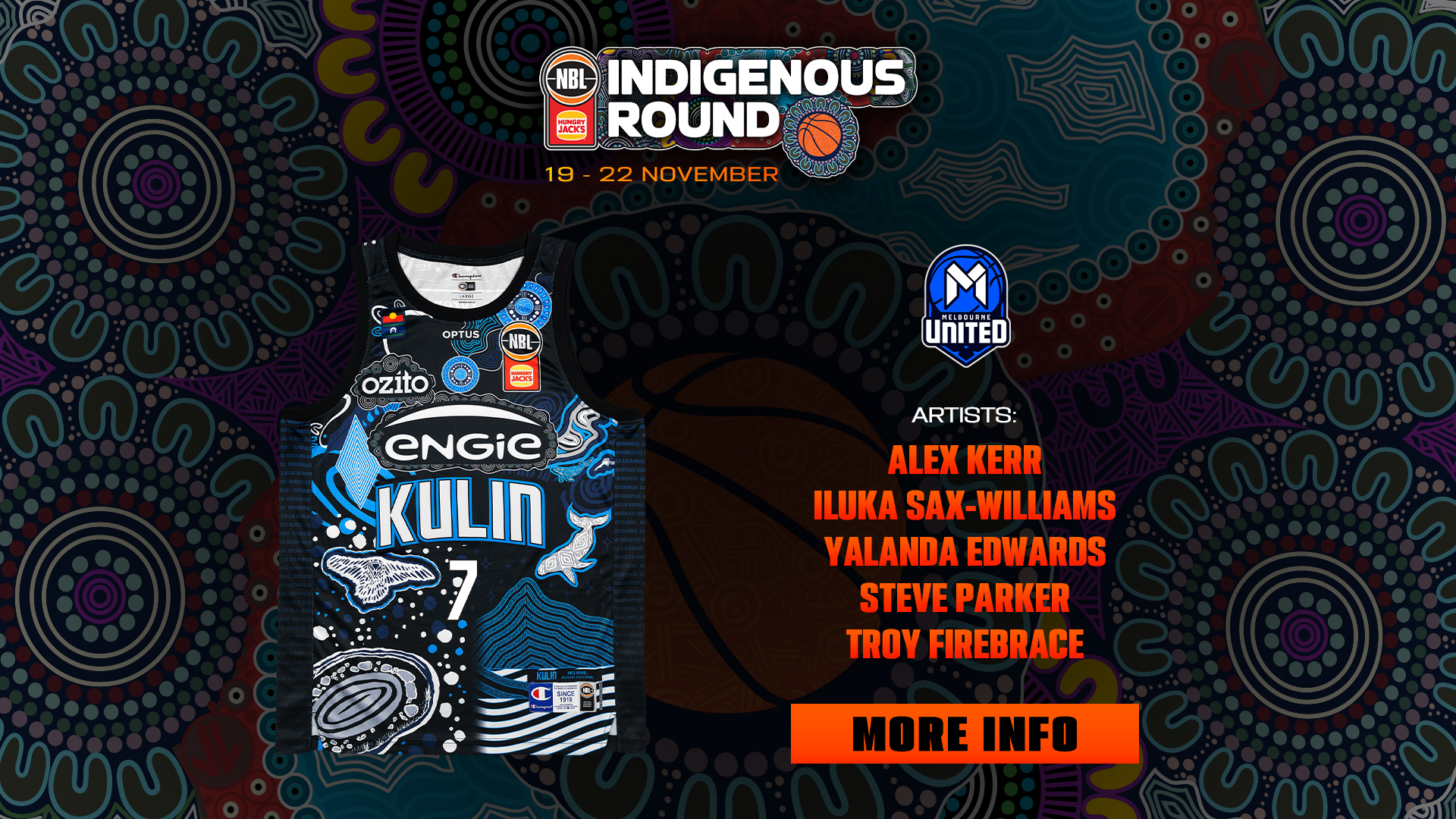
Artists: Wurundjeri’s Alex Kerr, Taungurung’s Iluka Sax-Williams, Wadawurrung’s Yalanda Edwards, Boonwurrung’s Steve Parker and Dja Dja Wurrung’s Troy Firebrace.
The Kulin Nation, United.
Introducing our NBL27 Indigenous Round uniform, the centrepiece of our Kulin Nation Project.
For the first time in Australian sport, we’ve brought together five Indigenous artists, one from each of the five groups of the Kulin Nation, to share their own stories of Country through art.
Representing the Wurundjeri, Boonwurrung, Dja Dja Wurrung, Taungurung and Wadawurrung peoples, five unique artworks have been brought together into one uniform, united under the KULIN wordmark.
More than just a jersey, the Kulin Nation Project is a celebration of culture, connection and community, using the power of basketball to bring people together and amplify First Nations voices.
We extend our sincere thanks to our project partners, Kinaway Chamber of Commerce and Trojan Tools, for their support in bringing this meaningful initiative to life.
Artwork story:
Alex Kerr: The background designs are all about Wurundjeri Country and the strong connections we have to the lands and waterways.
The connected circles and lines all being connected is a representation of everyone’s journey through country to where we are today.
The big meeting places are a representation of MU and the Kulin Nation sitting together and connecting, MU has a strong relationship with our First Nations people and this design showcases this.
Iluka Sax-Williams (Balayang): This artwork draws on the landscapes and stories of Taungurung people of the Kulin Nation, referencing the mountains, rivers, and waters that shape both the land and our people’s culture. These elements ground the work in place and honouring Country.
At the centre is Balayang, the Bat, known as Bundjil’s brother, moving within a cloud of bats across a glowing night sky. This imagery speaks to kinship, movement, and ancestral presence.
Bespoke stars near Mirnjan, the moon, references the story of the Seven Sisters, the Pleiades constellation. A story shared across Taungurung Country and the wider Kulin Nation that connects us to sky country.
Yalanda Edwards: This piece traces Geelong Bay and follows the curves of the Barwon River as it moves through St Leonards, Portarlington, Queenscliff, Barwon Heads, The Split between BH & Ocean Grove and Torquay, before returning home to the bay.
At the back Wurdi Youang (You Yangs) and the stone arrangement, one of the oldest astronomical stone arrangements to date.
It aligns with the setting sun at the solstices and equinoxes – it is a sacred artifactual structure that holds deep astronomical and seasonal knowledge on Waddawurrung country.
A black swan moves through Geelong Bay, honouring its significance to Wadawurrung women.
The work speaks to sustaining life through essential food sources such as eel & Murnong (yam daisy) also significant to women of the Kulin Nation and acknowledges the importance of the role they play in caring for Country through observing, gathering, collecting bush medicine and tucker. Women of the Kulin Nation were healers.
Bunjil & Waa sit above as the creators, reminding us of the moieties and laws that structured our kinship, responsibilities and balanced us as a nation.
Gum leaves, bush medicine, and the act of keeping the fire lit reflect women’s knowledge and deep observation of Country, often unseen yet vital to shaping when and how land was cared for, when fire was used, and how life was sustained on country through the changing of seasons.
This piece honours the layers of Country guided by generations of women whose knowledge & strength continue to flow like the waterways themselves.
Steve Parker (Boonwurrung Biik Kulin Ngarrgee Betayla Lidwik): Mapping of Boonwurrung Country from Werribee River around Naarm (Port Phillip Bay) down to Point Nepean and along the coast into our second bay Murranbiik, known as Western Port Bay. Up around Millowl (Phillip Island) right down to Wamoon (Wilsons Promontory).
Incorporated into the design is Betayla (whale) as they have been coming back through our waters again. Remembering that they weren’t coming through our waters for some time as they were hunted for quite some time by sealers and whalers.
We do a whale ceremony every year on Millowl to give Betayla safe passage in Boonwurrung coastal waters.
Also have the meeting place of the Kulin Nations Tanderrum 5 shields around the Camp fire for Ngarrgee (Ceremony).
Troy Firebrace (Djandak): The work speaks to the valuable circular knowledge embedded in the landscape that is protected and guided by cultural law.
Within Djaara Country there are many aspects of land that continue to be a valuable source for trade whether it be physical, mental or spiritual.
Bundjil is represented by the feather at the centre, continuing the protocol of respect when accessing knowledge from Country.
The flooding and drying of streams represented by the waterholes and flowing line work tells us when it’s appropriate in accordance with Country. By adhering to these laws we come to trade with valuable assets and artefacts depicted by shapes formed by patterns.
>> BUY YOUR FAVOURITE TEAM'S INDIGENOUS ROUND JERSEY NOW

Jersey to be revealed in coming days.

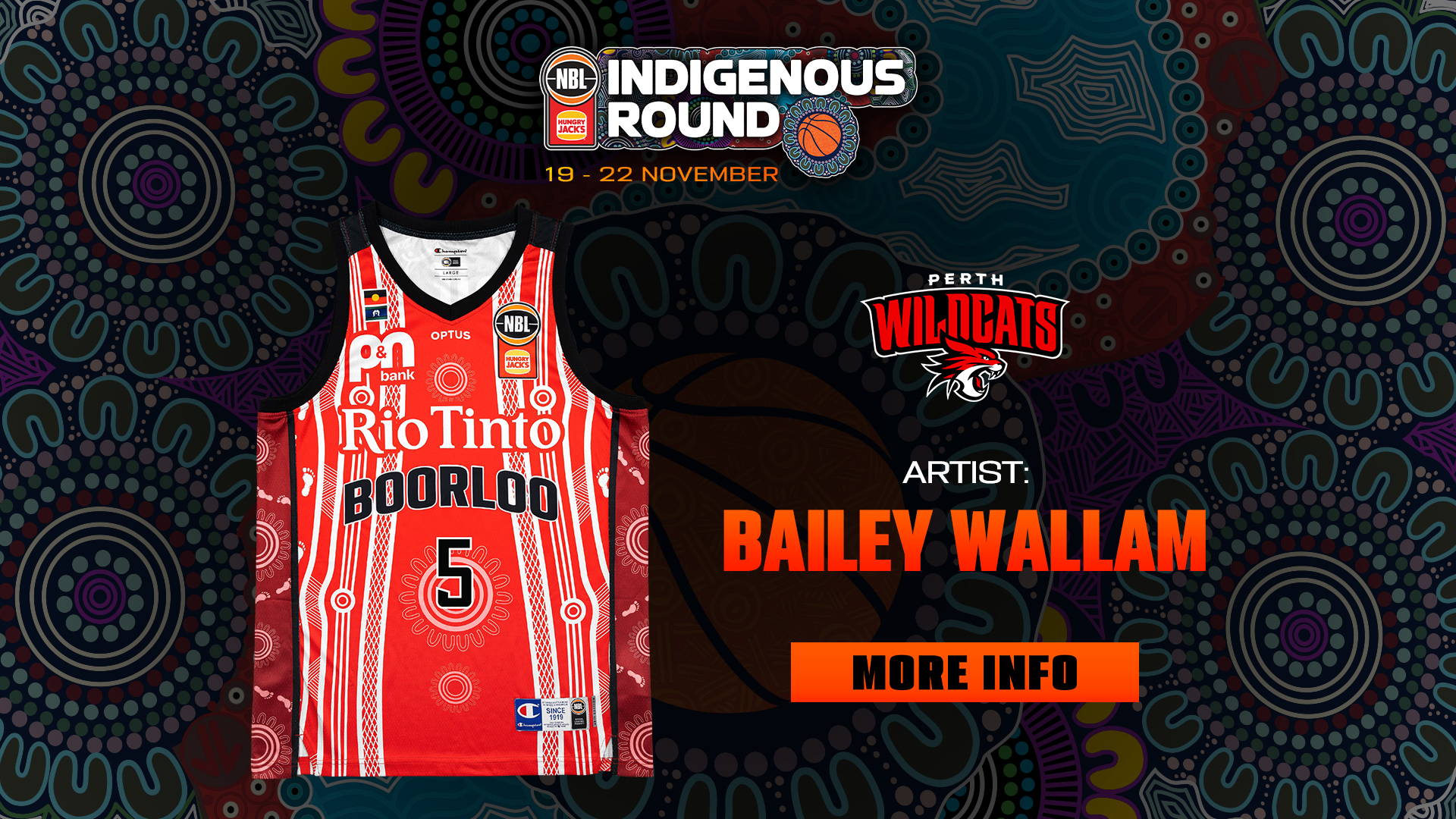
Artist: Bailey Wallam.
Artist bio: My name is Bailey Wallam, a Wilman and Koreng Noongar artist and the creator behind The Westside Project.
I have strong family connections to Wagin and Katanning, and I grew up on Whadjuk Noongar Boodjar, which continues to shape who I am and how I create.
I officially started my business at the end of 2024, focusing on hand-painted boots and shoes, and since then I have been fortunate to work with athletes across almost every major sporting league in Australia.
My art is deeply influenced by my culture. I take inspiration from traditional Noongar art, especially the work created by the children of Carrolup Native Settlement, whose pieces carry so much emotion and history.
I am also inspired by the art and creativity passed down through my own family, including my mum, aunty and grandparents, who have all played a role in shaping my style and passion.
Through The Westside Project, I aim to bring culture, storytelling and identity into a modern space, sharing it on a platform that reaches far beyond where I started.
Artwork story: The circles with arches are to represent all the communities that the Wildcats bring together.
The footprints are to represent the journey that the Wildcats have had to be the most successful club in the NBL.
The circles and lines between each one are to represent the Noongar communities around WA.
This is represent the body of the Wagyl and its importance to our people.
These are my representation of tree limbs as wood was a very important part of Noongar life.
Giving us tools to survive.
Finally we have the water around Perth that has provided the greater Noongar community with sustenance for thousands of years.

Artist: Tiffany Hunter.
Artist bio: Tiffany Hunter, a proud Aboriginal woman, founder, artist, mentor and founder of Tiffany Hunter Studio and Nerdu Badji Education.
Tiffany uses art as a powerful tool for storytelling, healing, cultural strengthening and connection.
Her work blends contemporary art with connection to her own story, identity and sense of belonging.
Through vibrant paintings, large-scale collaborations and workshops, Tiffany creates spaces where people can thrive, reflect on their own journeys and build stronger relationships with one another.
Whether painting, mentoring or speaking, Tiffany’s vision is to create lasting impact through creativity, storytelling, and meaningful change.
Artwork name: Rising from the Ashes.
Artwork story: The South East Melbourne Phoenix Heartland is more than basketball, it is about community, connection and creating opportunities for future generations across the South East suburbs of Melbourne and Gippsland, on the lands of the Wurundjeri Woi-wurrung people.
Wurundjeri people have cared for community, brought people together, shared knowledge and created strong pathways for others to grow and belong.
That same spirit is seen today through the Heartland, building safe and inclusive spaces where young people can feel supported, connected and inspired.
Just like Wurundjeri people have done for generations, the Heartland continues to strengthen community through leadership, resilience, teamwork and opportunity, showing the power of coming together and backing one another.
Stars symbolising the players and what it means to win a championship in the NBL, countless hours and sacrifice that goes into being a star player.
Butterfly symbolising evolving, continuing to develop the habits, characteristics and keep the vision strong whilst continuing to expand on winning the championship.
Leaf is a reminder of remembering to reflect on what shaped you, where you came from and your connection to country.
The Phoenix is a powerful symbol of resilience, renewal and rising stronger through adversity. The Phoenix is a bird that rises from the ashes after hardship, representing hope, growth and new beginnings.
For the South East Melbourne Phoenix, the name reflects strength, community spirit and the ability to rebuild, evolve and continue moving forward together.
A championship for the South East Melbourne Phoenix would represent resilience, pride and the power of the Heartland coming together. More than a title, it would inspire future generations and show what’s possible when a team rises from the ashes.
>> BUY YOUR FAVOURITE TEAM'S INDIGENOUS ROUND JERSEY NOW

Jersey to be revealed in coming days.

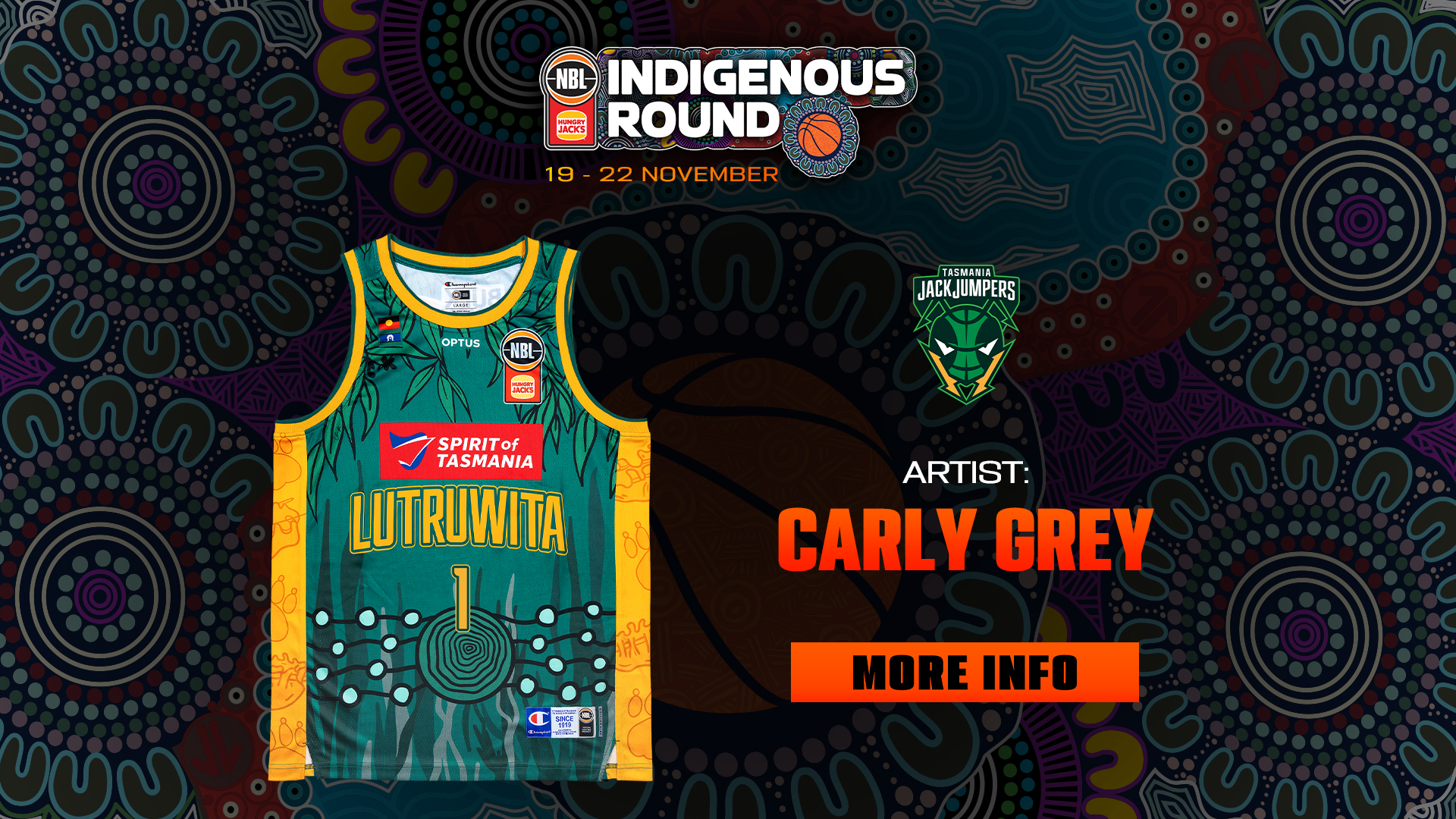
Artist: Carly Grey.
Artist bio: I am a palawa woman who grew up on the North West Coast of Lutruwita (Tasmania). I have lived on Noongar country (Western Australia) since 2019.
I completed a Bachelor of Arts majoring in Sociology and minoring in Aboriginal Studies. In December 2024 I completed my Master’s in Primary Education.
I am currently working in a First Nation Liaison role in a primary school as well as doing relief teaching on my off days. In my spare time I coach at a gym and work on projects for Krakani Creations, my art business.
I started my art journey in 2021 as an emotional outlet to connect to my heritage and build on my cultural identity. Using art, I have found stronger connections in my personal relationships through healing and educational conversations.
I hope to continue my artistic journey in the future as well as incorporating my knowledge into my teaching while I continue to learn and create.
Artwork story: This design tells a story connected to Tasmanian Aboriginal culture and Country. Flowing kelp forms the background, representing connection to sea, survival, and tradition.
At the centre sits a meeting place symbol, representing community, gathering, and shared stories.
Within this central space are nine pathways, representing that Tasmania traditionally had nine counties, symbolising journeys, connections, and the sharing of stories across places and people.
Surrounding the design are rock carving (petroglyph) symbols, with nine markings to represent nine countries, acknowledging growth, experience, and achievement over time.
Along the sides, nine Tasmanian tiger footprints run vertically, symbolising strength, identity, and connection to lutruwita (Tasmania), while honouring the past.
Additionally, on the side panels are seven kelp carriers, representing seven Indigenous rounds in the NBL, acknowledging culture, resilience, and the ongoing celebration of First Nations people within sport.
Shells line the bottom edges of the design on the shirts, representing the coastline, nourishment and cultural practices tied to these shells.

Jersey to be revealed in coming days.
